The rich text element allows you to create and format headings, paragraphs, blockquotes, images, and video all in one place instead of having to add and format them individually. Just double-click and easily create content.
A rich text element can be used with static or dynamic content. For static content, just drop it into any page and begin editing. For dynamic content, add a rich text field to any collection and then connect a rich text element to that field in the settings panel. Voila!
Headings, paragraphs, blockquotes, figures, images, and figure captions can all be styled after a class is added to the rich text element using the "When inside of" nested selector system.
The rich text element allows you to create and format headings, paragraphs, blockquotes, images, and video all in one place instead of having to add and format them individually. Just double-click and easily create content.
A rich text element can be used with static or dynamic content. For static content, just drop it into any page and begin editing. For dynamic content, add a rich text field to any collection and then connect a rich text element to that field in the settings panel. Voila!
Headings, paragraphs, blockquotes, figures, images, and figure captions can all be styled after a class is added to the rich text element using the "When inside of" nested selector system.


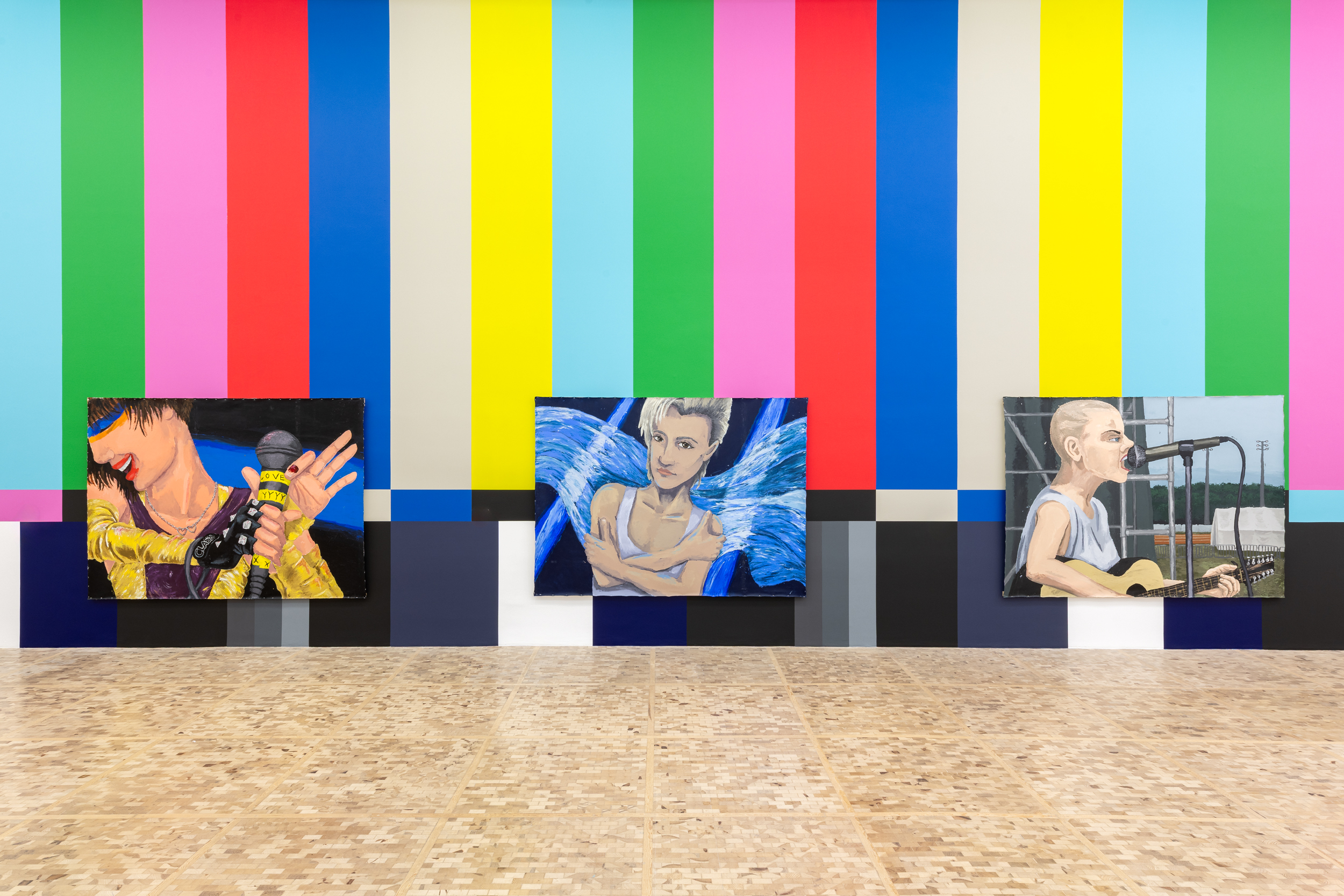
Alien Queen/ Strange Paradise brings together more than thirty large-scale paintings created over seven years by Manuela Solano (Mexico City, 1987). The exhibition is made up of portraits of real and fictional characters from the pop culture of the turn of the millennium that have become intimately intertwined with the artist’s personal life.
Drawing from her own experiences and painting directly with her hands, Solano revisits the aesthetics of the eighties, nineties, and 2000s, a time when the local and the global, the alternative and mass culture, intersected. She selects peculiar figures from music and fashion, film and television, the internet and magazines, to revive an imaginary tied to moments from her own biography: adolescence and coming of age, infatuation, partying, sorrows and serenity.
In this overview, Solano notes: “I lost my eyesight at the age of 26 due to an HIV-related infection that was negligently treated; visual culture and memory have come together in my practice since then.”
The dense layers of paint that emerge in these works reveal an intimate pictorial process, where memory exposes multiple contrasts and the strokes reveal the dilemmas arising both during production and in Solano’s personal life.
The works included in Alien Queen / Strange Paradise operate as a collection of self-portraits. They suggest that identity forged through time and shaped by our interactions and explorations of the world around us. The assumption of different roles enables us to address social challenges and to grow in new directions. In this sense, Manuela Solano understands identity asan act of both survival and subversion, with her work emerging not only from fragility but also from joy.
The exhibition invites viewers to recognize themselves in their own youth’s icons and to reflect on the roles they have assumed in the construction of their identities. With humor and irony, Solano proposes a space to laugh at oneself, to imagine other futures, and perhaps to uncover our hidden facets.
Image credit:
Alien Queen/Strange Paradise, Manuela Solano, Museo Tamayo, 2025.
Photographies by Gerardo Landa and Eduardo López (GLR Estudio).
Courtesy of Museo Tamayo.
Para socializar la heterogeneidad de voces que construyen la exposición colectiva OTRXS MUNDXS y profundizar en el discurso de las obras exhibidas en el Museo Tamayo, le pedimos a lxs artistas que nos hablen acerca de los conceptos o ideas que son importantes para expandir los discursos o motivaciones de su práctica.

Acrylic on canvas

Acrylic on canvas

As a child, I really liked the movie FernGully. The Last Rainforest (1992), because I loved rainforests and animals and magic. However, looking back at the movie now that I have grown and setting out to paint it, I see not only my love for the unmistakable look of the 90s, with Crysta’s shaggy hair turned into a slick wet look while magical little lights float around her. I see also how inviting her situation is, having an advantage over her human male counterpart due to her knowledge and magical powers. And yet how delicate and small she appears as she skips and plays around with him and lets herself be embraced by him, only to then disappear into a puff of glowing particles when he is about to kiss her.

Acrylic on canvas

Terminator 2 Judgment Day (1991) is not only one excellent movie. It is also an utmost synthesis of the spirit of a time —of what was frightening in the early 90s, what the early 90s looked like, and what was cool in the early 90s. But beside that, in this painting I wanted to capture John Connor’s cool, specifically. The natural cool of his cocky, defiant demeanor and the iconic cool afforded him by his unforgettable hair flip.

Acrylic on canvas

Queen of the Damned (2002) is not really a movie that I liked, but Aaliyah’s character, Akasha, was unquestionably unforgettable. Especially as she enters the nightclub, with her regal finery, with her vampire mouth and eyes and her undulating prowl. And also with how dangerous a combination her beauty, appetite and power turn out to be. Someone recently told me, as I related my weekend’s escapade at a sex club in Berlin, that they imagined me making my way through the club like Akasha as she hunts for blood. Though it’s not blood I’m after, I must make a mental note to remember to channel Akasha when I go out partying.

Acrylic on canvas

Few faces in our culture could be considered as iconic as Cher’s. When I set out to portray her, I knew I wanted to capture her features, of course, which have been a recurring image in pop culture for my generation as well as my parents’ and newer generations. But I also had this image in my head of Cher wearing some kind of feathered headdress. It was interesting to search for the right images to use as references, not only because Cher has been extremely prolific and always very extravagant in her style, but also because her features have changed slightly through the decades. I would like to think that I am presenting her not just as a camp expression of style, but as an artist who is constantly using her talent and her body to perform and deliver, in a way that feels to me as almost ritualistic or magical.

Acrylic on canvas

The song of the same title by Roxette, as well as the music video shot in 1990, are quintessential to some of the things I love the most: the aesthetic of the 80s and 90s, strong women and power ballads. Roxette, in my opinion, perfected the genre of the power ballad. And the singer, Marie Fredriksson, even if I didn’t see her image as many times as I did other celebrities, stayed etched in my memory. Especially in one particular instant in the video for It Must Have Been Love, where she, with her strong shoulders and minimal white dress and cool hair, is hugging herself and tilting her face down as she gazes at the viewer and sings. For whatever reason, the combination of this gesture and her look in this one instant stuck in my memory as an embodiment of strength and confidence, while also showing that she feels small and lonely.

Acrylic on canvas

Sinéad O’Connor has both inspired me to make works that have turned out to be very important to me, and triggered self-reflections that have resulted in big changes in my life. Impersonating her for a performance piece ended up being one of the experiences that made me realize that I’m transgender. It’s been more than a decade, and Sinéad has died, but to me she is still best comprehended in the video of the live performance of her song Troy at the Pinkpop Festival in 1988. Singing is, in my opinion, the purest and most potent medium of human expression. And in that video Sinéad, who becomes almost a dragon rather than a human, delivers one of the most consummate performances of any work of art, ever.

Acrylic on canvas

I used to play video games growing up, but not as much as other people. As an adult, before I became blind, I returned periodically to a few video games, some of them for how much I loved looking at them. Yoshi’s Island (1995) was a two-dimensional, linear gameplay. But the backgrounds were made of several distinct layers that, from the bottom of the screen to the top, were rendered in progressively less saturated colors and which scrolled by at decreasing speeds, creating the impression of an enormous depth of field. In these two paintings, I wanted to create landscapes, the way some Romantic painters did, that convey a reverence towards the sublime vastness of the nature they embody.

Acrylic on canvas

I used to play video games growing up, but not as much as other people. As an adult, before I became blind, I returned periodically to a few video games, some of them for how much I loved looking at them. Yoshi’s Island (1995) was a two-dimensional, linear gameplay. But the backgrounds were made of several distinct layers that, from the bottom of the screen to the top, were rendered in progressively less saturated colors and which scrolled by at decreasing speeds, creating the impression of an enormous depth of field. In these two paintings, I wanted to create landscapes, the way some Romantic painters did, that convey a reverence towards the sublime vastness of the nature they embody.

Acrylic on canvas

Rather than the actual Gia Marie Carangi, I painted the actress Angelina Jolie in her portrayal of the tragic life and death of the famous supermodel. In the film Gia (1998), one is swept off by the character —someone so captivatingly beautiful and ferociously alive that the world kept demanding more of her, someone who seems to always aim to live everything to the fullest and yet is at odds with her own success—, and simultaneously also by the soul-tearing performance by Angelina Jolie, which is, in my opinion, one of the most accomplished performances I ever got to see in a movie. In this painting, I want Angelina to gaze at the viewer, half challenging and half invitingly, in an image where her physical beauty is almost incidental, and her unruliness and hunger for life are what is delivered. One line from the movie stuck with me:
“I should have been a rock star, but I can’t sing”.

Acrylic on canvas

I think that I found, as a little child, the film The Never Ending Story (1984) equally mesmerizing and terrifying. A couple times throughout the movie, one is presented with a challenge which is impossible to surmount unless one has absolute faith in oneself: quicksand that consumes you if you succumb to sadness, a portal where two sphinxes will kill you instantly if you have but one shred of fear in your heart. Many years have passed and I have faced a few challenges that have seemed impossible to survive. I have never managed not to entertain my sadnesses and I haven’t learned not to be afraid. But I have done my best to stay true and come out my own self on the other side beyond.

Acrylic on canvas

When I think about the iconic character of the film The Never Ending Story (1984), I am struck by a diverse set of contradictions, besides how much I love the aesthetic of her settings. She is like a child in her appearance and her size, yet she is ageless and infinitely wise. She is the empress of a whole universe, and yet is isolated from it and unable to leave her Ivory Tower. Even with all her beauty and power, she always struck me as contemplative, if not sad.

Acrylic on canvas

This is a portrait of Kathy Bates’s character in the film Fried Green Tomatoes (1991), in a scene where she has fashioned herself a dress out of kitchen plastic film and is now waiting to greet her husband when he returns from work. Whereas this scene struck me as funny and perhaps a bit ridiculous when I watched the film as a child with my mother for the first time, even back then and all the more strongly now, I am stuck with something else. This person, who is lonely and frustrated by her social role as a housewife, is mustering up her
coquettishness and creativity in order to try to reignite passion in her marriage and in her life. I am stuck with her almost heroic process of self-affirmation and the unforgettable tenderness of the movie.

Acrylic on canvas

This character from the anime series Dragon Ball Z (1989-1996) kept popping up in my mind and, knowing the rest of my work, it is no surprise. Here we have an alien being who is not only extremely strong and powerful, but also very elegant and beautiful in an uncanny way. For this portrait, I took the liberty of, rather than painting the character exactly as he appears in the TV show, portraying him even more stylized and poised.

Acrylic on canvas

In this portrait of Marge Simpson, I wanted to capture what I think is her character at its most complex and in a situation that I think I have felt myself in throughout my life and career. She has, by chance, had access to a new social status as a result of finding a Chanel suit in a thrift store. She becomes enamored with this new upper-class environment of the exclusive country club that she begins to attend. However, she is forced to confront the disparity between this new world she is desperately wanting to become a part of and her true, more modest socio-economic background, to the point that it causes her and her values and family relations to suffer as she strains to give an image of wealth and refinement. And yet, in one decisive move, she pushes even farther by spending their savings on a new gown at a Chanel boutique, only to then feel a tender loneliness when she sees how apart she has grown from her family (Scenes from the Class Struggle in Springfield, 1996).

Acrylic on canvas

I’ve never been a fan of Christina Aguilera or her music. So, it took me a long time to decipher why her persona in the music video for Dirrty (2022) got so stuck in my head that I decided to portray her. Come to think of it, in Dirrty, my generation saw Christina in a way that I don’t think we had seen a pop star yet. We had seen pop stars being cute and even seductive or sexy, but not so overtly dirty or rough. The music video for Dirrty showed us Christina as an almost completely new and extremely bold character that was not just evidently sexually charged, but also presented in a way that, at least in that industry, was not associated with female sexuality—with her dirty-looking hair and skin, her unglamorous outfits and sets, and her aggressive singing and dancing and associations with boxing and fighting. Back when I was a teenager and this video came out, all of these things seemed jarring. Who would have known that, now that I’m an adult and with my current nightlife habits, Christina’s call to get hot and get dirty would seem so much closer to my tastes.

Acrylic on canvas

This is a portrait of Daryl Hannah’s character in the film Clan of the Cave Bear (1986). Ayla is first a defenseless little girl who finds herself isolated, adopted by a tribe of Neanderthals and being the only human amongst them. As she grows up, she goes from being made to feel inferior and being used as a sexual object by the men in the tribe, to discovering her physical strength and her unique gift for healing. I wanted to capture her not as a sexy female movie character, but as uncanny and potent with her ritual body paint and Daryl Hannah’s androgynous features.

Acrylic on canvas

Ursula might have been not only the first Disney villain who was truly charming and alluring, but absolutely the best character in The Little Mermaid (1989). And I love her most as she is exultantly and confidently doing her hair and make-up, as she seduces Ariel and the viewer into a very risky proposition.

Acrylic on canvas

Once I set out to portray Ursula, I immediately felt compelled to also portray her human-form alter ego. Where, as a child, she only struck me as evidently ill-intentioned and dangerous with her subtle smirk and dark gaze, now that I’m an adult and now that I’m a woman, I can’t help seeing considerably more of myself and my wants in her. I too am a brunette. I wish I too had powerful magic that could ensnare people and make a gorgeous prince fall in love with me. And I wish I too could magically obtain a beautiful singing voice to change my deep and unfitting natural voice.

Acrylic on canvas

This is a portrait of Kirsten Dunst’s character in the film Interview with the Vampire (1994), a little girl who gets turned into a vampire and is adopted by two vampires. Throughout the film, she grows from a completely innocent and helpless little girl into a frighteningly powerful and ambitious woman who is haunted by the knowledge that she is trapped forever in the body of a small child and isolated from the rest of humankind forever.

Acrylic on canvas

This painting depicts my own version of the famous vampire, borrowing heavily from Herzog’s film Nosferatu. Phantom Der Nacht (1979). However, when producing the sketch for his face, I designed it to have a more androgynous appearance than in the film and to slightly resemble me. My life has been marked by a constant loneliness and an unsatisfiable hunger for more. And I have always had the impression that this is misinterpreted by others, same as most people don’t realize that what drives a vampire is not hunger, but loneliness.

Acrylic on canvas

This is a portrait of the unpopular character from the film Star Wars Episode I The Phantom Menace (1999). This character has gone down in history as an annoyingly stupid laughingstock. However, when I first saw him, I thought he was one of the coolest, most beautiful and elegant alien creatures I’d ever seen. I remember wishing I looked like him. I chose to portray him beaming invitingly at the viewer. And he gives the impression of being outgoing, sensual and fun-loving, being that he is shirtless and has pierced nipples.

Acrylic on canvas

Back around the time I enrolled in Art School, I noticed a certain shift in the aesthetics of the internet, especially on platforms like Myspace and Tumblr. There seemed to be a renewed love for a certain type of images that were uncanny and queer, in the broad sense of such words. More and more, people my age on the internet were obsessing over images that came from or reminded of the 80s and 90s because of their color palette or texture, or perhaps had a certain makeshift quality or a collection of apparently contradictory or unexpected elements. One of the first such images which captured my attention depicted a small woman wearing a flimsy sheer pink dress that let her nipples be seen, seated atop a horse which seemed made out of fiberglass or papier maché, as though riding it. This image had a soft focus fuzzy glimmer about it and was clearly staged in a photography studio. However, the clash between the earnest and innocent expression on the woman’s face, the evident cheap quality of the horse figure and the sexually suggestive styling, made me wonder who had thought of creating this image and whatever for. And it captivated me immediately. Later, I found out the woman portrayed is actually La Toya Jackson.

Acrylic on canvas

When I watched the Netflix docuseries Wild, Wild Country (2018) about Ma Anand Sheela and her involvement in the crimes and scandals surrounding the cult of the guru Osho, I was obsessed. I have re-watched it dozens of times. Sheela seems to me almost like a character from a movie. A villain and an anti-heroine. She is simultaneously a ruthless conspirator without scruples in the furthering of her ambitions, as well as an unbelievably capable and strong woman whose character seems impossible to assassinate. I wanted to portray her as though sitting for an interview, with a bright smile on her face, basking in the knowledge of the aversion she faces and the knowledge of her power.

Acrylic on canvas

This painting portrays the actress Fairuza Balk in her iconic role in the film The Craft (1996). She, the leader of a quartet of teenage witches, has successfully invoked the supreme spirit and acquired from him an immense power. A power which harnesses the magic of nature and enables her to walk on water, but which, mishandled, ultimately drives her mad.

Acrylic on canvas

This portrait of the American pop singer condenses my fascination for tension and contradiction in her persona. I love how she goes through the world of pop celebrity by simultaneously catering to mainstream taste and incorporating elements that one might consider alternative. I’d describe her as Alternative Basic. And I love how she seems to be doing it not to deceive or sell herself as something she is not. I get the impression that she is genuinely herself, she is genuinely a basic pop star who is incorporating elements of alternative culture that she genuinely loves, and she’s doing it for the fun of it and for the sake of expressing herself. I may not like her music, but I’d definitely love to hang out with her.

Acrylic on canvas

I wanted to paint the iconic image from the 90s film of the same name because, not representing a film that I admire or even actresses that I particularly admire, it was still stuck in my head. I love the pairing of this image with the title Wild Things (1998). Yes, of course the title carries certain innuendoes, the implication that these characters are wild in the sexual sense. However, to me, the image doesn’t capture that. Rather, we see them gazing warily or even menacingly at the viewer, just barely above the surface of an inscrutable darkness. This image, for me, carries the implication that these are potentially dangerous creatures, not unlike a wild animal in a swamp.

Acrylic on canvas

I painted two versions of this painting. I wanted to portray Nina Hagen’s iconic post-punk look, the fierceness and power that her singing and her onstage attitude communicate. However, when I was finished painting her with an open mouth, screaming into the microphone, I realized that something was amiss. I felt like I had portrayed her as we all already know her: a fully charged, savage musical force. But I wasn’t feeling fully charged and roaring at the time, I was feeling contemplative and I was feeling alone. So I portrayed her again, still the same onstage character, still the same potential, but instead gazing seriously at the viewer as though analyzing or waiting for an answer. In a way, isolated by her power.

Acrylic on canvas

This is a portrait of the ultra-wealthy televangelist. When I first saw her, I was stricken by how someone with such a religious and conservative outlook would also choose to present herself in such a manner that she seems quite flamboyant and extravagant. At first glance, I thought she was not a religious preacher, but a drag queen. Come to think of it, it could be said that her personal style does indeed qualify as drag.

Acrylic on canvas

This painting depicts the torso of a child in a playground. The child is posing facing the viewer with arms akimbo and wears a large, white T-shirt bearing the cover for Mexican child pop star Fey’s debut album (1995). The T-shirt has been knotted at one side and a scrunchie adorns the knot, giving the T-shirt the look of a crop top, the same way Fey herself used to wear it. I wanted the look of the playground, the scrunchies, the high-waisted blue jeans and the Fey reference all to remind of the nineties in Mexico City. Fey is a complex element for me. Many people remember her as a bubbly, somewhat silly, pop figure delivering music for children. However, over time, I have come to develop a great appreciation for her songs, including some of the lesser-known ones, her highly-challenging and poetic lyrics and her role as a trendsetter. Also, I see in her a talented performer, with quality musical work behind her, who was often marketed and received as over-simplified and made to be cute, when there was more to her than that.

Acrylic on canvas

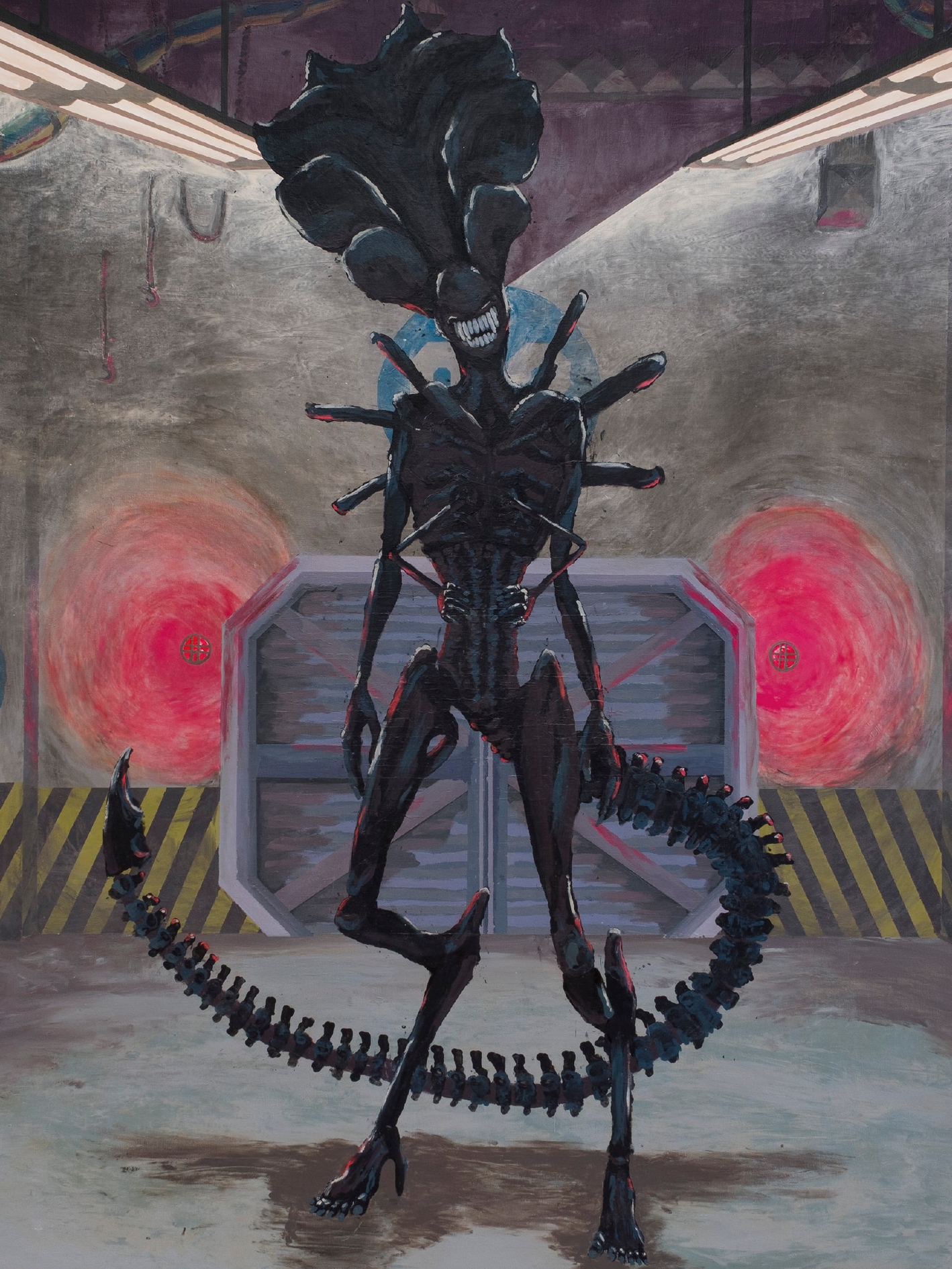
I portrayed the Alien Queen from the film Aliens (1986), presenting her not as a mere antagonist or monster, but as a powerful and magnificent being, facing the viewer and posing with an attitude of proud grandeur, which I think befits not just the Alien Queen as a character within the context of the movie, but also the emblematic aesthetic of H.R. Giger, who designed her.

Acrylic on canvas

In this portrait of the pop singer, she is on stage as seen in a live performance with the Iberian Octet at the ceremony for the Premios de la Música awards in 1998. Her signature half-black half-white hair is tastefully slicked back and held in a tight bun. She is wearing elegant make-up and jewelry. However, in a manner characteristic of her and of the time, she is also wearing a very revealing dress which could only be described as endearingly kitsch. I am fascinated by the tension between her small frame and beautiful breasts and her somewhat masculine features and booming, roaring voice. The clash between her unquestionable talent and beauty and her undeniably camp and over-the-top presence.

Acrylic on canvas

In this portrait of the famous extraterrestrial, we see him in drag and standing at the threshold of a closet and smiling at the viewer. The image presents a character who is simultaneously disrupting gender expectations of society and coming from an alien world, but coming with love, friendship and healing.

Acrylic on canvas

This painting depicts Jennifer Lopez’s character in the film The Cell (2000), in which she delves into the surreal, hellish kingdom inside the mind of a serial murderer. Catherine becomes trapped, bewitched and enslaved, and the villain uses her to ensnare the other main character, who has gone into this realm to try to rescue her. Whereas before she used to be a strictly professional and down-to-business investigator, here we see her trapped by an evil man into the role of sex slave and temptress.

Acrylic on canvas

It is said that a fool is he who stares at the finger that points at the moon. This nugget of wisdom was stuck in my mind when reviewing the film E.T. the Extra-Terrestrial (1982) for potential paintings. A scene in the movie shows E.T., who has just single-handedly invented and built a device which enables him to communicate with intelligent beings outside our world. He is pointing at the sky through the window, trying to explain to his human friends. The boys, however, seem to focus on the fact that their little sister has put women’s clothes and accessories on their alien friend whom they perceive as male.
Niñeces entre 6 y 12 años de edad están invitadas a disfrutar el viernes de consejo técnico de noviembre, indicado por la Secretaría de Educación Pública, en una sesión dedicada a crear historias a partir de obras de las exposiciones Alien Queen/ Paraíso extraño y Futuros Arcaicos. Los participantes ejercitarán su imaginación, habilidad fundamental para apreciar y gozar el arte así como para fortalecer tanto el pensamiento creativo como la empatía.
Mediadores del Museo Tamayo animaremos y acompañaremos a las niñeces en la creación de su propio cuento ilustrado, integrando personajes y paisajes que encontrarán durante las visitas lúdicas que haremos por las exposiciones; crearán así una memoria de la visita.
A la par trabajaremos, de la siguiente manera, habilidades artísticas que ampliarán el abanico de recursos creativos y expresivos de los participantes:
Consideraciones importantes
Las niñas y los niños del Club conversarán con la artista Manuela Solano a partir de una serie de preguntas para conocer su obra y también para acercarse a su estilo de vida en Berlín, ciudad donde radica.
Esta conversación forma parte de las experiencias lúdicas y participativas que abarca el programa del Club de niños del museo, encaminadas a propiciar la interacción y el diálogo entre los niñxs y de ellos con artistas, curadores y otras personalidades del arte contemporáneo.
En esta conversación, la artista Manuela Solano (Ciudad de México, 1987) compartirá aspectos de su producción artística, la cual explora la formación de la identidad, la memoria y el sentido del humor.
Luego de estudiar la licenciatura en Artes Visuales en la Escuela Nacional de Pintura, Escultura y Grabado “La Esmeralda”, la artista cursó estudios en la École Nationale Supérieure des Beaux-Arts de Lyon, en Francia.
Ha presentado su obra individualmente en Dundee Contemporary Arts (2022), Pivô, São Paulo (2021), Kunsthalle Lissabon (2021), el Institute of Contemporary Art de Miami (2018) y en el Museo de Arte Carrillo Gil (2016).
Alien Queen/Paraíso Extraño, en el Museo Tamayo (2025), es la más grande exposición individual que ha presentado hasta el momento.
Solano ha participado en exposiciones colectivas en el Henie Onstad Kunstsenter (2022), el Palais de Tokyo (2019), el New Museum (2018) y el Museo Universitario del Chopo (2014). Su obra forma parte de las colecciones de ICA y el Pérez Art Museum de Miami, la Fundación ARCO de Madrid y el Solomon R. Guggenheim Museum de Nueva York. Vive y trabaja actualmente en Berlín.
Alien Queen/Strange Paradise brings together more than thirty large-scale paintings created over seven years by Manuela Solano (Mexico City, 1987). The exhibition is made up of portraits of real and fictional characters from the pop culture of the turn of the millennium that have become intimately intertwined with the artist’s personal life.
Drawing from her own experiences and painting directly with her hands, Solano revisits the aesthetics of the eighties, nineties, and 2000s, where the local and the global, the alternative and mass culture, intersect. She selects peculiar figures from music and fashion, film and television, the internet and magazines, to revive an imaginary tied to moments from her own biography: adolescence and adulthood, loves and afflictions, parties and calmness.
In this overview, Solano notes: “I lost my sight at the age of 26 due to an HIV-related infection that was negligently treated; since then, visual culture and memory have come together in my practice.” The dense layers of paint that emerge in these works reveal an intimate pictorial process, where memory exposes multiple contrasts and the strokes expose the dilemmas arising both during production and in Solano’s personal life.
The works included in Alien Queen/Strange Paradise operate as a collection of self-portraits. They suggest that identity forged through time and shaped by the interactions and explorations of the world around us. The assumption of different roles enables us to address social challenges and to grow in new directions. In this sense, Manuela Solano understands identity as an act of both survival and subversion, with her work emerging not only from fragility but also from pleasure.
The exhibition invites viewers to recognize themselves in their own youth’s icons and to reflect on the roles they have assumed in the construction of their identities. With humor and irony, Solano proposes a space to laugh at oneself, to imagine other futures, and perhaps to discover our hidden facets.


Paseo de la Reforma 51
Bosque de Chapultepec
Miguel Hidalgo
C.P. 11580
Map
Stay connected!
Instagram
Facebook
X
YouTube